
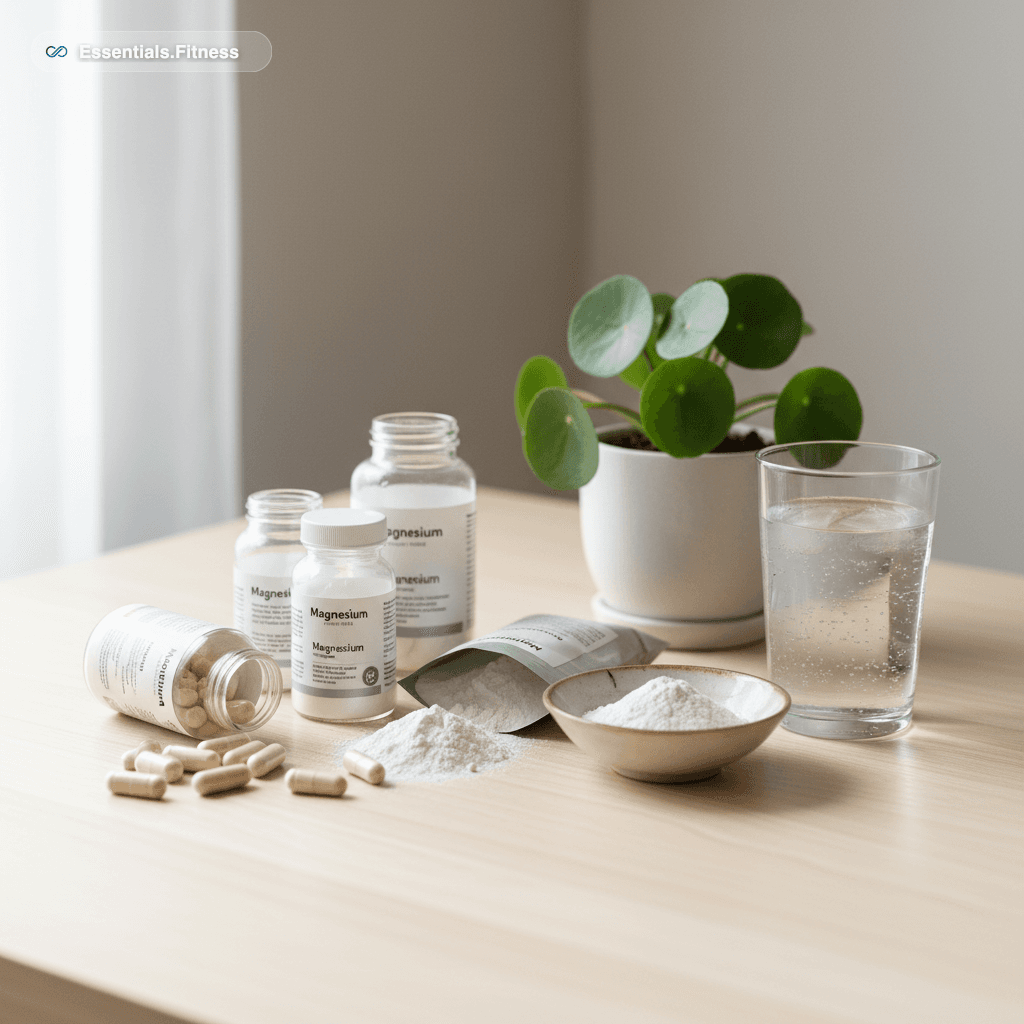
Magnesium Supplements: Which Form Works, and for What?
Bisglycinate for sleep, citrate for digestion, oxide best avoided. Which magnesium form actually helps with which question, with dose recommendations and the data.
Contents
Direct answer: which form matches which goal
Magnesium bisglycinate is the first choice for sleep and a gentle stomach. Magnesium citrate fixes constipation, with a mildly laxative effect. Magnesium malate is popular for daytime fatigue. Magnesium oxide has plenty of magnesium per tablet but lousy bioavailability. Which form fits which question is backed by studies, with small but consistent effect sizes.
If your goal is sleep, take 200 to 300 mg bisglycinate 30 to 60 minutes before bed. If your goal is bowel regulation, take 200 mg citrate in the morning. If your goal is "I take magnesium because everyone does", you probably don't need it.
What magnesium actually does
Magnesium is a cofactor in over 300 enzymatic reactions: ATP synthesis, protein synthesis, muscle contraction (via the calcium-magnesium balance), and nerve conduction. Daily intake: roughly 350 mg for men, 300 mg for women.
About 60 percent of body magnesium sits in bone, 38 percent intracellularly in muscle and soft tissue, less than 1 percent in blood. That makes serum magnesium a poor status marker, it stays normal long after stores have run down.
What the evidence actually shows
For nocturnal calf cramps the evidence is thin. A 2025 meta-analysis shows no statistically significant difference between magnesium and control in weekly cramp frequency (Wang et al. 2025). People with low baseline intake do tend to benefit more often.
In sport, performance effects are small at adequate baseline, moderate with deficiency. High-intensity sweating can drive magnesium losses of 10 to 20 mg per session, which adds up over a multi-week training camp without replacement.
Forms compared
Form | Magnesium content | Bioavailability | Main use |
|---|---|---|---|
Bisglycinate | 14 % | Very good | Sleep, stomach-friendly |
Citrate | 11 % | Good | Bowel regulation, mildly laxative |
Malate | 7 % | Good | Daytime fatigue, energy |
Glycerophosphate | 12 % | Good | General supplementation |
Threonate | 8 % | Good | Cognition, crosses blood-brain barrier better |
Oxide | 60 % | Poor (4 %) | Bowel regulation, otherwise avoid |
Sulfate | 10 % | Poor | Epsom salt, laxative only |
Carbonate | 28 % | Moderate | Heartburn relief |
Magnesium content means: how much elemental magnesium per gram of compound. A 500 mg magnesium-bisglycinate tablet contains about 70 mg elemental magnesium.
Dose: how much and when
On a normal diet, whole grains, green vegetables, nuts, and dark chocolate cover the daily need. Eating 200 g almonds, 150 g spinach, or 100 g dark chocolate puts you at about 100 to 150 mg magnesium from those sources alone.
Supplement doses are typically 200 to 400 mg elemental magnesium per day. More than 400 mg in one go often triggers loose stools, the body tolerates only so much per bolus. Higher targets should split across two meals.
Who benefits most
- People with low magnesium intake (under 200 mg/day from food): biggest effect
- Athletes with high training volume: cumulative sweat losses
- People with sleep complaints: bisglycinate shows small but consistent effects
- People with reflux: carbonate or bisglycinate (gentle on stomach)
- Postmenopausal women: bone health, often low intake
Strength trainees on a balanced diet with no sleep issues don't need a magnesium supplement. The cramp-protection myth isn't supported, but it's harmless.
What's still open
Whether the more expensive forms (threonate, premium bisglycinates) are worth the markup isn't cleanly shown. Most head-to-head studies show small to zero differences in clinical endpoints, even with measured differences in bioavailability.
The effect of magnesium on mood, anxiety, and depression is widely discussed but inconsistently supported. Small RCTs show effects, larger meta-analyses are more cautious.
Short: bisglycinate for sleep, citrate for bowel function, a balanced diet as the base. Taking magnesium without a clear question is optimisation at the margin.

Frequently asked questions
Does magnesium help against cramps?
At adequate intake, barely. A 2025 meta-analysis shows no statistically significant effect. People with low baseline intake (or who sweat heavily) can benefit. Check diet and hydration first.
What's the best magnesium form?
Depends on the goal: bisglycinate for sleep and a gentle stomach, citrate for bowel regulation, threonate for cognition (debated). Glycerophosphate is a solid all-rounder.
Can I take magnesium with other minerals?
Calcium and magnesium compete for absorption; at high calcium doses, separate magnesium by 2 hours. Zinc at the same time is fine. Antibiotics need 2 hours apart.
What about magnesium spray or transdermal magnesium?
The data is very thin. There's barely any solid evidence that transdermal magnesium raises blood levels meaningfully. If at all, the effect is small. Oral is the reliable route.
Sources & Studies
- [1]Bomar et al.. Short-Term Magnesium Supplementation Has Modest Detrimental Effects on Cycle Ergometer Exercise Performance and Skeletal Muscle Mitochondria and Negligible Effects on the Gut Microbiota: A Randomized Crossover Clinical Trial. (2025). 10.1016/j.tjnut.2025.03.002
- [2]Reno et al.. Effects of magnesium supplementation on muscle soreness in different type of physical activities: a systematic review. (2024). 10.1186/s12970-024-00735-3
- [3]Rawji et al.. Examining the Effects of Supplemental Magnesium on Self-Reported Anxiety and Sleep Quality: A Systematic Review. (2024). 10.7759/cureus.59317
- [4]Mah and Pitre. Oral magnesium supplementation for insomnia in older adults: a Systematic Review & Meta-Analysis. (2021). 10.1186/s12906-021-03297-z
- [5]Hausenblas et al.. Magnesium-L-threonate improves sleep quality and daytime functioning in adults with self-reported sleep problems: A randomized controlled trial. (2024). 10.1016/j.sleepx.2024.100121
- [6]Walker et al.. Comparative Clinical Study on Magnesium Absorption and Side Effects After Oral Intake of Microencapsulated Magnesium Versus Other Magnesium Sources. (2024). 10.3390/nu16244367
Comments
Be the first to leave a comment.
You might also like

Caffeine Before Training: What the Studies Really Show on Performance, Dose, and Sleep
Caffeine raises performance by 2 to 5 percent across endurance, strength, and sprint. What the studies actually say on dose, timing, CYP1A2 genetics, and sleep, and when the trade-off flips.
Beta-Alanine: What Studies on Carnosine, Performance and Tingling Actually Show
Beta-alanine works in a narrow window between 60 and 240 seconds of high-intensity effort. What the trials actually say about dose, effect size, target users and the famous paresthesia.

Ashwagandha for Athletes: What the Studies on Strength, Cortisol, and Sleep Really Show
Ashwagandha shows three clear effects in the evidence: lower cortisol under stress, better sleep, and modest strength gains in training-naive men. The widely advertised testosterone boost is real only in a narrow group. Here is what the RCTs on KSM-66, Sensoril, and Shoden actually say about dose, form, and limitations.
Creatine: what studies really show about muscle, strength, safety and the well-known myths
Creatine is the most studied supplement in sports science. This summary shows what pooled meta-analyses actually say about strength, muscle gain, kidneys, hair loss and cognitive effects, and where the evidence is thinner than the marketing copy suggests.