
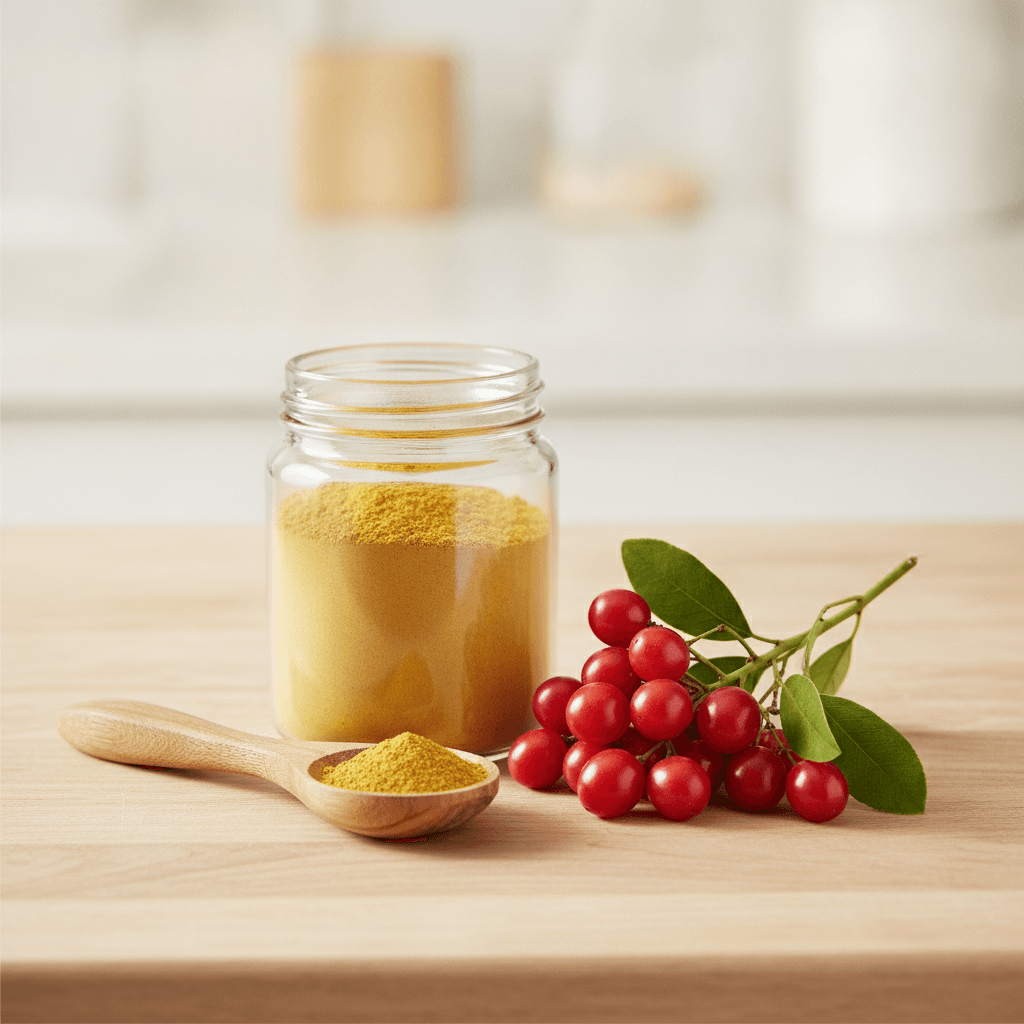
Ashwagandha for Athletes: What the Studies on Strength, Cortisol, and Sleep Really Show
Ashwagandha shows three clear effects in the evidence: lower cortisol under stress, better sleep, and modest strength gains in training-naive men. The widely advertised testosterone boost is real only in a narrow group. Here is what the RCTs on KSM-66, Sensoril, and Shoden actually say about dose, form, and limitations.
Contents
Ashwagandha shows three clearly documented effects in the studies: lower cortisol under stress, better sleep, and slightly more strength in untrained men. The flashier claims you'll see in marketing (testosterone surge, big VO₂max jump) sit on the weakest evidence. That's the whole post in two sentences.
The strong effects apply to a specific profile: stressed or poorly-sleeping adults, often training beginners, in studies using 250 to 600 milligrams per day for at least six weeks. In trained athletes who already sleep well and don't carry chronic stress, the effect shrinks noticeably. That's not negative, it's just honest.
What ashwagandha actually is
Ashwagandha (Withania somnifera) is a plant from Ayurvedic medicine. In a supplement context, only one component matters: the withanolides, a group of steroidal lactones from the root and leaf. Most studies use one of three standardized extracts:
- KSM-66: root extract, at least 5 percent withanolides. The most common form in RCTs.
- Sensoril: aqueous root-and-leaf extract, 10 percent withanolides. Dosed slightly lower.
- Shoden: highly concentrated withanolide glycosides, 35 percent withanolides. Smallest daily dose (120 to 240 mg).
"Ashwagandha 600 mg" without a standardization label tells you almost nothing, because a cheap root powder at 600 mg might contain 1 percent withanolides, a tenth of the active substance in standardized KSM-66. When buying, look for "X mg withanolides" or a named branded extract.
Strength and muscle: solid evidence, but in untrained men
The most-cited study is Wankhede et al. 2015: 57 training-naive men (18 to 50 years), 600 mg KSM-66 per day over 8 weeks alongside progressive resistance training. Result: bench press 1RM rose 46 kg in the ashwagandha group versus 26.4 kg on placebo, nearly double the gain. Lean body mass grew 1.7 kg more than placebo. p < 0.001.
It sounds impressive but carries three important caveats. First: training-naive men. Beginners boost their bench press extremely fast in the first months anyway, the headroom for "more" is huge. Second: small sample (n=57). Third: the study was co-funded by the extract's manufacturer.
A replication with a different extract, Ziegenfuss et al. 2018, confirmed the trend in 38 recreationally active men: squat 1RM rose 19.1 kg on 500 mg Sensoril versus 10 kg on placebo (p = 0.009) after 12 weeks. Again small sample, again no highly-trained cohort.
The meta-analysis by Bonilla et al. 2021 pools 13 studies and finds a medium effect size for strength and power (pooled effect 0.67). What the meta-analysis can't answer: does the effect hold in trained athletes? The data on that is thin. If you've been lifting for three years and progressing linearly, don't expect a second Wankhede study.
Cortisol and stress: the strongest evidence
Salve et al. 2019 compared 250 mg per day, 600 mg per day, and placebo in 58 stressed adults (Perceived Stress Score above 20) over 8 weeks. Serum cortisol dropped significantly on 600 mg versus placebo (p < 0.0001). On 250 mg cortisol also fell, but more weakly. Subjective stress score dropped similarly in both dose groups.
This is the most reliably replicated effect. What the studies do NOT directly show: that this cortisol drop improves training progress in a normal, non-chronically-stressed athlete. For someone with chronically elevated cortisol, poor sleep, and high work load the effect is plausible. For a relaxed 25-year-old with good sleep, probably not measurable.
Sleep: clearly better, but moderate effect size
Deshpande et al. 2020 gave 144 adults with non-restorative sleep 120 mg Shoden per day over 6 weeks. 72 percent of the treatment group reported improved sleep quality versus 29 percent on placebo. Sleep latency, efficiency, and total sleep time all improved measurably. The effects are clear but moderate, not at sleep-medication level, more in the range of what you get from good sleep hygiene or regular training.
Testosterone: only in one specific population
Lopresti et al. 2019 is the cited source for the testosterone effect: 57 overweight men (40 to 70 years) with mild fatigue, 8 weeks of Shoden in a crossover design. Testosterone rose by 14.7 percent versus placebo (p = 0.010). It's a real effect, but in a narrow corridor: older, overweight, fatigue-burdened men with likely borderline baseline testosterone. Clinically relevant outcomes (sexual function, energy perception) did NOT differ significantly from placebo. The hormone reading went up, the felt life did not.
For a 30-year-old man with normal testosterone, there is no good evidence that ashwagandha measurably raises it. If you want to lower cortisol you still benefit, just via better sleep, less stress, and indirectly better recovery.
Dose, form, and timing
Goal | Form | Daily dose | Duration | Study |
|---|---|---|---|---|
Stress, cortisol | KSM-66 | 250 to 600 mg | 6 to 8 weeks | Salve 2019 |
Sleep quality | Shoden | 120 mg | 6 weeks | Deshpande 2020 |
Strength (beginners) | KSM-66 | 600 mg | 8 weeks | Wankhede 2015 |
Testosterone (40+, overweight) | Shoden | about 21 mg WGS | 8 weeks | Lopresti 2019 |
Safety and caveats
The evidence synthesis by Sprengel et al. 2025 concludes: overall well tolerated, mild side effects (drowsiness, mild gastric discomfort) are the most commonly reported. Six documented cases of reversible liver injury at 450 to 1,350 mg per day appear in the literature, rare but real. For pre-existing liver issues, thyroid disorders (ashwagandha can alter TSH), pregnancy, or autoimmune disease, talk to your doctor first.
What the evidence does not show
Three claims that show up in marketing and don't hold up in the studies: that ashwagandha raises testosterone in any man (it only does so in older, overweight men with fatigue), that it's a pre-workout booster (it works slowly and cumulatively, not acutely), and that it boosts VO₂max by double-digit percent (the meta-analysis shows a large effect, but the underlying studies are small and heterogeneous). Other studied compounds like beta-alanine or beetroot nitrate act more directly on performance parameters.
If you want an adaptogen with actually-studied effects, ashwagandha delivers solid cortisol and sleep evidence. No more. But also no less.
Frequently asked questions
Can I stack ashwagandha with creatine?
Yes, the mechanisms don't overlap. Creatine acts directly on phosphate energy, ashwagandha indirectly via cortisol and sleep. No unfavorable interaction has been reported in the studies.
How long can I take ashwagandha continuously?
Most RCTs run 6 to 12 weeks. Longer-duration studies are rare; a 24-week trial showed no safety issues. As a precaution, pause for 4 to 8 weeks after 12 weeks or have liver and thyroid markers checked by your doctor.
Will taking it at night leave me groggy in the morning?
For most subjects in Deshpande 2020, no. If daytime sleepiness shows up, halve the dose or switch to a midday dose. Sleep-promoting effects are moderate, not hypnotic.
Do I need a specific standardization label?
Yes. "Ashwagandha 600 mg" without further detail tells you nothing about the withanolide concentration. Look for KSM-66, Sensoril, Shoden, or at least the withanolide milligram label on the bottle.
Sources & Studies
- [1]Wankhede S, Langade D, Joshi K, Sinha SR, Bhattacharyya S. Examining the effect of Withania somnifera supplementation on muscle strength and recovery: a randomized controlled trial. (2015). 10.1186/s12970-015-0104-9
- [2]Ziegenfuss TN, Kedia AW, Sandrock JE, Raub BJ, Kerksick CM, Lopez HL. Effects of an Aqueous Extract of Withania somnifera on Strength Training Adaptations and Recovery: The STAR Trial. (2018). 10.3390/nu10111807
- [3]Salve J, Pate S, Debnath K, Langade D. Adaptogenic and Anxiolytic Effects of Ashwagandha Root Extract in Healthy Adults: A Double-blind, Randomized, Placebo-controlled Clinical Study. (2019). 10.7759/cureus.6466
- [4]Deshpande A, Irani N, Balkrishnan R, Benny IR. A randomized, double blind, placebo controlled study to evaluate the effects of ashwagandha (Withania somnifera) extract on sleep quality in healthy adults. (2020). 10.1016/j.sleep.2020.03.012
- [5]Lopresti AL, Drummond PD, Smith SJ. A Randomized, Double-Blind, Placebo-Controlled, Crossover Study Examining the Hormonal and Vitality Effects of Ashwagandha (Withania somnifera) in Aging, Overweight Males. (2019). 10.1177/1557988319835985
- [6]Bonilla DA, Moreno Y, Gho C, Petro JL, Odriozola-Martínez A, Kreider RB. Effects of Ashwagandha (Withania somnifera) on Physical Performance: Systematic Review and Bayesian Meta-Analysis. (2021). 10.3390/jfmk6010020
- [7]Sprengel ML, Bingel U, Schedlowski M. Withania somnifera (Ashwagandha) supplementation: a review of its mechanisms, health benefits, and role in sports performance. (2025). 10.1186/s12986-025-00925-y
Comments
Be the first to leave a comment.