
How to treat DOMS the evidence-based way: massage, tart cherry and ice baths in 2026
DOMS doesn't come from lactic acid. It comes from micro-tears under eccentric loading. What massage, tart cherry, compression, ice baths and stretching actually do for muscle soreness, according to the latest meta-analyses.
Contents
- What's really happening with muscle soreness
- Massage and foam rolling: what the data shows
- Massage
- Foam rolling
- Nutrition: tart cherry and BCAAs
- Compression garments: the old assumption no longer holds
- Cold water immersion: recovery versus muscle growth
- What demonstrably doesn't help: stretching for DOMS
- What you should actually do
DOMS doesn't come from lactic acid. It comes from microscopic tears in the Z-disks of your muscle fibers, triggered by eccentric loading. It peaks 24 to 48 hours after the session and resolves within three to four days. Massage and tart cherry juice give measurable relief. Compression and stretching don't. Ice baths help recovery but cost muscle growth.
What's really happening with muscle soreness
DOMS (delayed onset muscle soreness) isn't what most people think. No lactic acid buildup. Instead, microscopic tears in the Z-disks of your muscle fibers, triggered by eccentric loading (lengthening under tension, for example running downhill or the lowering phase of a bench press).
Pain starts 12 to 24 hours after training, peaks at 24 to 48 hours, and is mostly gone by 72 to 96 hours. It's accompanied by a rise in blood creatine kinase (CK), an indirect marker of muscle damage, and a short-term strength drop of 5 to 20 percent.
One important point upfront: mild soreness is normal training feedback, especially after a new stimulus or coming back from a break. Extreme soreness isn't "good pain". It's a sign of overdosed volume or a step-up that was too fast. More recovery demand means lower possible training frequency, so longer gaps between sessions for the same muscle group.
Massage and foam rolling: what the data shows
Massage
A meta-analysis by Davis et al. 2020 of 29 studies and 1,012 participants found a small but statistically significant reduction in perceived DOMS from post-training sports massage. On objective performance measures (sprint, jump, maximum strength), massage had no measurable effect.
That matches the current umbrella review by Wiecha et al. 2025, which summarizes 29 reviews and 863 individual studies: massage is one of four evidence-supported DOMS measures, alongside cold applications, contrast baths and phototherapy.
Likely mechanism: increased local blood flow and reduced secondary inflammatory mediators, not "pushing the lactic acid out".
Foam rolling
Foam rolling is a cheap self-massage variant. A meta-analysis by Skinner et al. 2020 of 32 studies found a large effect on range of motion (d = 0.76 over 13 studies). Training performance wasn't impaired.
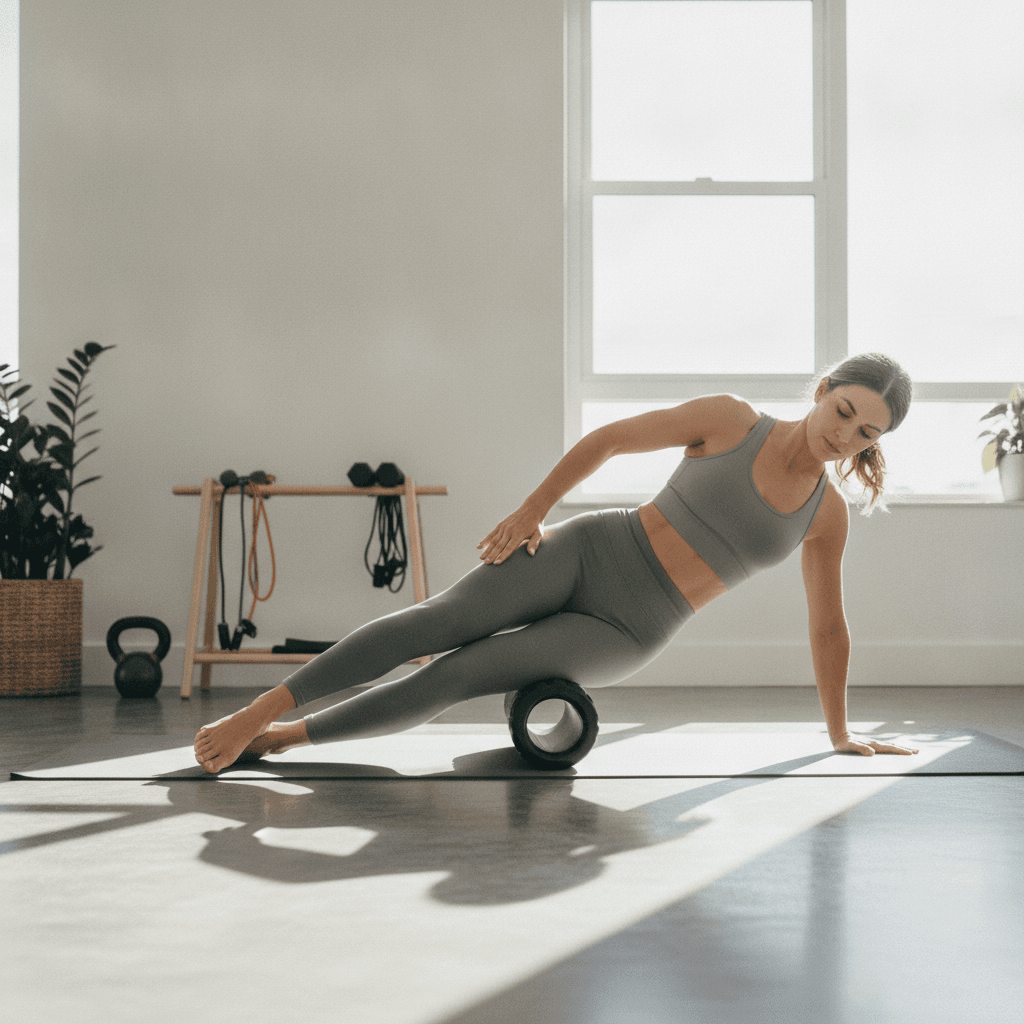
For DOMS specifically the data is thinner than for classical massage. It plausibly helps but isn't as robustly documented. Practical rule of thumb: 60 to 90 seconds per muscle group on the day after hard training, slow movement, lingering a bit where it's tight.
Nutrition: tart cherry and BCAAs
For supplements there are two compounds with their own meta-analyses.
Concentrated tart cherry juice (Montmorency variety) is dosed in most studies at 30 ml of concentrate or about 240 ml of diluted juice twice daily, starting 4 to 5 days before the stress and continuing 2 to 3 days after the hard stimulus.
BCAAs are the more contested topic. A recent meta-analysis by Salem et al. 2024 of 18 studies found a strong DOMS reduction (g = -1.75 at 48 hours, g = -1.82 at 72 hours). The older review by Fouré and Bendahan 2017 warns, though: many studies are methodologically weak, and the effect disappears when total protein intake is sufficient.
Practical reading: at 1.6 to 2.2 g protein per kg body weight per day, spread over 3 to 5 meals, the BCAA benefit is minimal (see the protein powder post). If you eat barely any protein and still train hard, you'll benefit measurably.
Compression garments: the old assumption no longer holds
Most sports-gear brands advertise faster recovery from compression socks or recovery tights. A meta-analysis by Négyesi et al. 2022 of 19 RCTs and 350 participants found no clinically meaningful effect: strength recovery didn't improve, regardless of whether compression was worn during or after training (effect sizes between -0.03 and 0.26).
Older reviews from 2013 had reported positive effects. The difference: newer work addressed methodological gaps, especially missing blinding of participants. Honest answer in 2026: compression can feel pleasant, but a demonstrable recovery boost isn't there.
Cold water immersion: recovery versus muscle growth
The ice bath after training is well documented for DOMS reduction but it costs elsewhere. A network meta-analysis by Wang et al. 2025 of 55 RCTs defines the optimal dose: 10 to 15 minutes at 11 to 15 degrees Celsius for DOMS, similar for CK reduction.
Programming consequence: before a competition or tournament, where the next day matters more than muscle growth, cold water is a defensible choice. Inside a hypertrophy block, switch to other recovery methods.
What demonstrably doesn't help: stretching for DOMS
Static stretching before or after training is the most popular DOMS prevention. It doesn't work. A Cochrane review by Herbert et al. 2011 covering 12 RCTs (including one field study of 2,377 participants) reached a clear conclusion: stretching, whether before, after, or before and after exercise, doesn't produce clinically meaningful reductions in DOMS in healthy adults.
The current 2025 umbrella review by Wiecha confirms this: evidence for stretching against DOMS remains weak. Stretching has value for mobility and for certain sport-specific movement patterns, but as DOMS prophylaxis it's useless.
What you should actually do
The evidence hierarchy, top to bottom:
1. Sleep, the underrated recovery measure. Seven to nine hours the night after hard training (see the sleep and strength training post). 2. Protein intake at 1.6 to 2.2 g per kg body weight, spread over 3 to 5 meals. 3. Active recovery at low intensity (easy walk, very low-intensity Zone 2 cardio, see the Zone 2 post) for 20 to 40 minutes the next day. 4. Massage or foam rolling the day after hard training, 5 to 10 minutes per affected muscle group. 5. Tart cherry juice during phases of unusually high load (marathon, training camp, competition phase). Overkill in routine training.
What you can skip without missing anything: static stretching aimed at DOMS prevention, compression garments as a recovery booster, ice baths after strength training when muscle growth is the goal.
Safety check: real DOMS is diffuse, affects the whole muscle belly, and eases briefly with movement. Sharp, localized pain, swelling, a bruise, or persistent severe pain beyond five days isn't DOMS but a possible injury. When in doubt, see a doctor.
Frequently asked questions
Does magnesium help against muscle soreness?
There is no solid data showing magnesium specifically reduces DOMS. Magnesium has its place for cramp tendency and confirmed deficiency, but as a targeted soreness aid it isn't backed by RCTs. If you sweat regularly, basic supplementation can make sense, but not as a DOMS remedy.
Should I rest or keep training through DOMS?
With mild to moderate soreness, low-intensity movement is fine and subjectively speeds recovery. Hard training of the same muscle group is a bad idea: maximum strength is down 5 to 20 percent and injury risk goes up. Easy cardio or training a different muscle group are okay.
When is muscle soreness a warning sign?
If the pain is localized (one spot) rather than diffuse, comes with swelling, a bruise or restricted range of motion, or lasts longer than five days, it's probably not DOMS but a strain or muscle tear. Time to see a doctor.
Sources & Studies
- [1]Davis HL, Alabed S, Chico TJA. Effect of sports massage on performance and recovery: a systematic review and meta-analysis. (2020). 10.1136/bmjsem-2019-000614
- [2]Wiecha S et al.. Physical Therapies for Delayed-Onset Muscle Soreness: An Umbrella and Mapping Systematic Review with Meta-meta-analysis. (2025). 10.1007/s40279-025-02187-5
- [3]Skinner B, Moss R, Hammond L. A systematic review and meta-analysis of the effects of foam rolling on range of motion, recovery and markers of athletic performance. (2020). 10.1016/j.jbmt.2020.01.007
- [4]Hill JA, Keane KM, Quinlan R, Howatson G. Tart Cherry Supplementation and Recovery From Strenuous Exercise: A Systematic Review and Meta-Analysis. (2021). 10.1123/ijsnem.2020-0145
- [5]Salem A et al.. Attenuating Muscle Damage Biomarkers and Muscle Soreness After an Exercise-Induced Muscle Damage with Branched-Chain Amino Acid Supplementation: A Systematic Review and Meta-analysis with Meta-regression. (2024). 10.1186/s40798-024-00686-9
- [6]Fouré A, Bendahan D. Is Branched-Chain Amino Acids Supplementation an Efficient Nutritional Strategy to Alleviate Skeletal Muscle Damage? A Systematic Review. (2017). 10.3390/nu9101047
- [7]Négyesi J, Hortobágyi T, Hill J, Granacher U, Nagatomi R. Can Compression Garments Reduce the Deleterious Effects of Physical Exercise on Muscle Strength? A Systematic Review and Meta-Analyses. (2022). 10.1007/s40279-022-01681-4
- [8]Wang H, Wang L, Pan Y. Impact of different doses of cold water immersion on recovery from acute exercise-induced muscle damage: a network meta-analysis. (2025). 10.3389/fphys.2025.1525726
- [9]Piñero A et al.. Throwing cold water on muscle growth: A systematic review with meta-analysis of the effects of postexercise cold water immersion on resistance training-induced hypertrophy. (2024). 10.1002/ejsc.12074
- [10]Herbert RD, de Noronha M, Kamper SJ. Stretching to prevent or reduce muscle soreness after exercise (Cochrane Review). (2011). 10.1002/14651858.CD004577.pub3
Comments
Be the first to leave a comment.