
Plyometric Training: What Jump Work Actually Does for Power, Sprint and Bone
Plyometrics measurably boosts jump, sprint, and agility but leaves maximal strength and hypertrophy almost untouched. Here is what the dose-response data shows, where drop-jump height tips into risk, and what the evidence in older adults really says.
Contents
The direct answer: what plyometrics actually delivers
More jump height, more sprint speed, more leg power. A 2025 meta-analysis of 30 RCTs in trained adults (Sun et al. 2025) shows medium-to-large effects on jumping power (ES 0.65 to 0.81), sprint (ES 0.42 to 0.58), and agility (ES 0.49). Maximum strength (1RM squat, leg press) climbs weakly (ES 0.32). Hypertrophy doesn't move. Plyometrics is an explosive-strength technique, not a muscle-building tool.
If your goal is bigger quads, read a different post. If your goal is jumping higher, accelerating faster, or moving more reactively in sport, keep going.
What plyometric training actually is
Plyometrics uses the stretch-shortening cycle (SSC): a short eccentric stretch on landing or countermovement, followed by an immediate concentric contraction on push-off. The tendon stores energy like a spring, the stretch reflex fires the muscle harder, and the result is more force per unit time than a purely willed concentric movement (Davies et al. 2015).
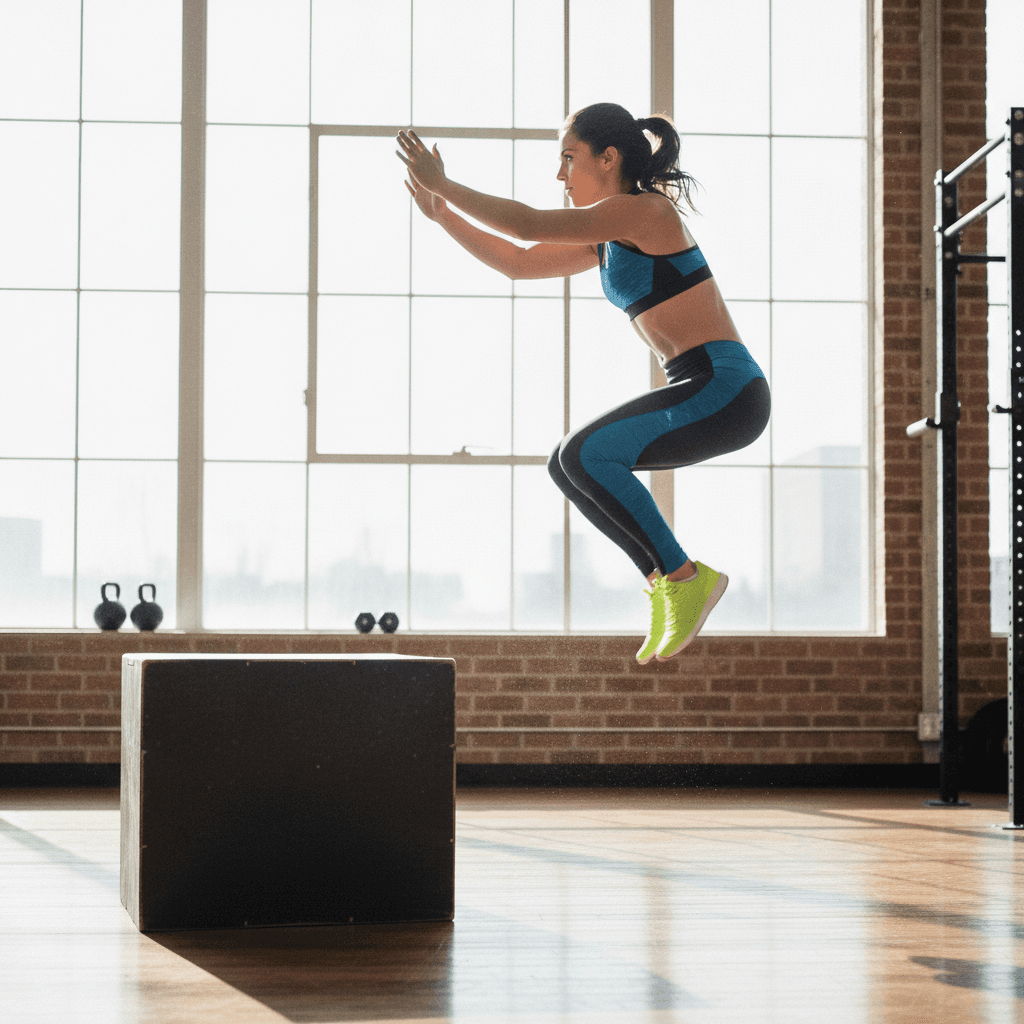
Typical drills: box jumps (jump onto a box), drop jumps (step off a box, land and immediately jump back up), squat jumps, bounds (alternating long jumps), skipping, clap push-ups. Ground contact time under 250 milliseconds counts as truly reactive. Anything longer is jumping rather than plyo.
What counts as a ground contact
A ground contact is one complete land-and-push-off. Three sets of 5 box jumps is 15 ground contacts. A series of 10 alternating skips counts each foot strike separately, so 10. Sounds pedantic, but it matters for the dose table below.
What the evidence actually shows
In women, jumping, sprinting, and change of direction respond similarly well. A 2025 meta-analysis of 14 RCTs in roughly 500 adult female athletes found medium effects on jump and sprint, large effects on change of direction (Ramirez-Campillo et al. 2025).
Adolescent soccer players from 18 RCTs: plus 6 to 9 percent vertical jump, faster 10-metre sprints, better reactive strength (Yang et al. 2025).
Maximum strength is a thinner story. Plyometrics moves 1RM only when classic strength training runs in parallel. Pure jump programs without barbell work produce almost no hypertrophy and only small strength gains. If you want quads, you still need squats. That lines up with our piece on weekly training volume: muscle grows on volume, not speed.
Older adults: safe and worth it
A systematic review of 16 studies in 446 subjects over 60 found zero injury-related dropouts in properly progressed programs (Vetrovsky et al. 2019). Jumping power, leg strength, and functional tests like the 5-time sit-to-stand or stair climb improved clearly.
A 2020 RCT in 30 men over 65 showed: an age-adapted plyo program (3x per week, 12 weeks, low hops with wall support, slow progression) brought similar or larger gains in jump power and functional capacity than classic strength training (Vetrovsky et al. 2020).
Bone density is the open question. Plyometric loading produces high ground reaction forces (3 to 6 times bodyweight on drop jumps), which should be osteogenic in theory. The evidence in older adults is mixed: some studies show preserved hip bone density, almost none show a clear increase. More impact on fall prevention and reactive control than on DXA numbers.
Dose: how much is enough
Stage | Frequency | Contacts per session | Contacts per week |
|---|---|---|---|
Beginner | 1 to 2x/week | 60 to 100 | 100 to 150 |
Intermediate | 2 to 3x/week | 100 to 150 | 200 to 350 |
In-season athlete | 2x/week | 80 to 120 | 150 to 240 |
Across the meta-analyses, the sweet spot sits around 8 to 12 weeks, 2 sessions a week, moderate volume. More than 3 sessions a week or over 200 contacts per session shows diminishing returns and rising injury reports (Sun et al. 2025).
48 hours between sessions is non-negotiable. Reactive load hits tendons harder than muscle, and tendons recover slower. If you do box jumps Monday, the next plyo day is Wednesday, not Tuesday.
Injury risk and landing
The two most common mistakes are too much volume too soon and bad landing technique. Stiff, asymmetric landings drive force straight into knees and ankles. An Achilles overloaded today doesn't answer tomorrow, it answers 6 weeks later with tendinopathy.
Landing checklist: knees over mid-foot (no inward collapse), hips and knees absorb actively, torso upright, contact quiet. If the landing slaps loud, the load is too high or the technique is off.
Drop-jump heights over 60 centimetres are athlete territory. For most lifters, 30 to 40 centimetres is the upper end, and only after several weeks on lower boxes. A fitness tracker with an accelerometer can roughly log ground contact time and jump height, but it's no substitute for a side-on phone video of the landing.
What's still open
How well plyometrics transfers to non-specific movement patterns (a tennis serve after a box-jump block, say) is still debated. Most effect studies measure jump and sprint, not sport-specific output. Whether plyometrics measurably slows sarcopenia in trained adults over 40 is also not cleanly answered. The mechanics suggest yes, the data is thin.
One thing's clear: if you never train fast, you won't be reactive. Plyometrics is the tool that doesn't replace the heavy barbell, but adds to it. Short version: it doesn't fit everyone, but it fits more people than most lifters assume.




Frequently asked questions
Are squat jumps already plyometrics?
Yes, if your ground contact stays short (under 250 milliseconds) and you push off fully. Squat jumps with a long pause in the bottom are jumps with rest, not real reactive plyometrics.
How high should the box be on box jumps?
High enough that you land upright in a quarter-squat, not crawling out of a deep one. Rule: 10 cm lower and clean beats 10 cm higher with a rounded back. Drop jumps above 60 cm are athlete territory.
Can I do plyometrics if I have never lifted?
Ground-based drills like squat jumps and skips, yes. Box jumps and drop jumps only after 4 to 8 weeks of basic strength work, so tendons and ligaments can carry the load.
How do I measure ground contact time without a lab?
Roughly with a fitness tracker or smartphone app that estimates it from the accelerometer. For a coaching eye, a side-on slow-motion video often suffices: if you push off the floor audibly and the foot stays down under 0.3 seconds, you are reactive.
Sources & Studies
- [1]Sun Y, et al.. Effects of plyometrics training on lower limb strength, power, agility, and body composition in athletically trained adults: systematic review and meta-analysis. (2025). 10.1038/s41598-025-10652-4
- [2]Ramirez-Campillo R, et al.. From a female perspective: plyometric training's impact on jump, sprint, and change-of-direction performance in adult female athletes: a systematic review and meta-analysis. (2025). https://pmc.ncbi.nlm.nih.gov/articles/PMC12477254/
- [3]Yang Y, et al.. Effects of plyometric training on jump, sprint, and change of direction performance in adolescent soccer player: A systematic review with meta-analysis. (2025). https://pmc.ncbi.nlm.nih.gov/articles/PMC12040276/
- [4]Vetrovsky T, et al.. The Efficacy and Safety of Lower-Limb Plyometric Training in Older Adults: A Systematic Review. (2019). https://www.ncbi.nlm.nih.gov/pmc/articles/PMC6349785/
- [5]Vetrovsky T, et al.. An age-adapted plyometric exercise program improves dynamic strength, jump performance and functional capacity in older men either similarly or more than traditional resistance training. (2020). https://www.ncbi.nlm.nih.gov/pmc/articles/PMC7447006/
- [6]Davies G, Riemann BL, Manske R. Current Concepts of Plyometric Exercise. (2015). https://pmc.ncbi.nlm.nih.gov/articles/PMC4637913/
Comments
Be the first to leave a comment.