
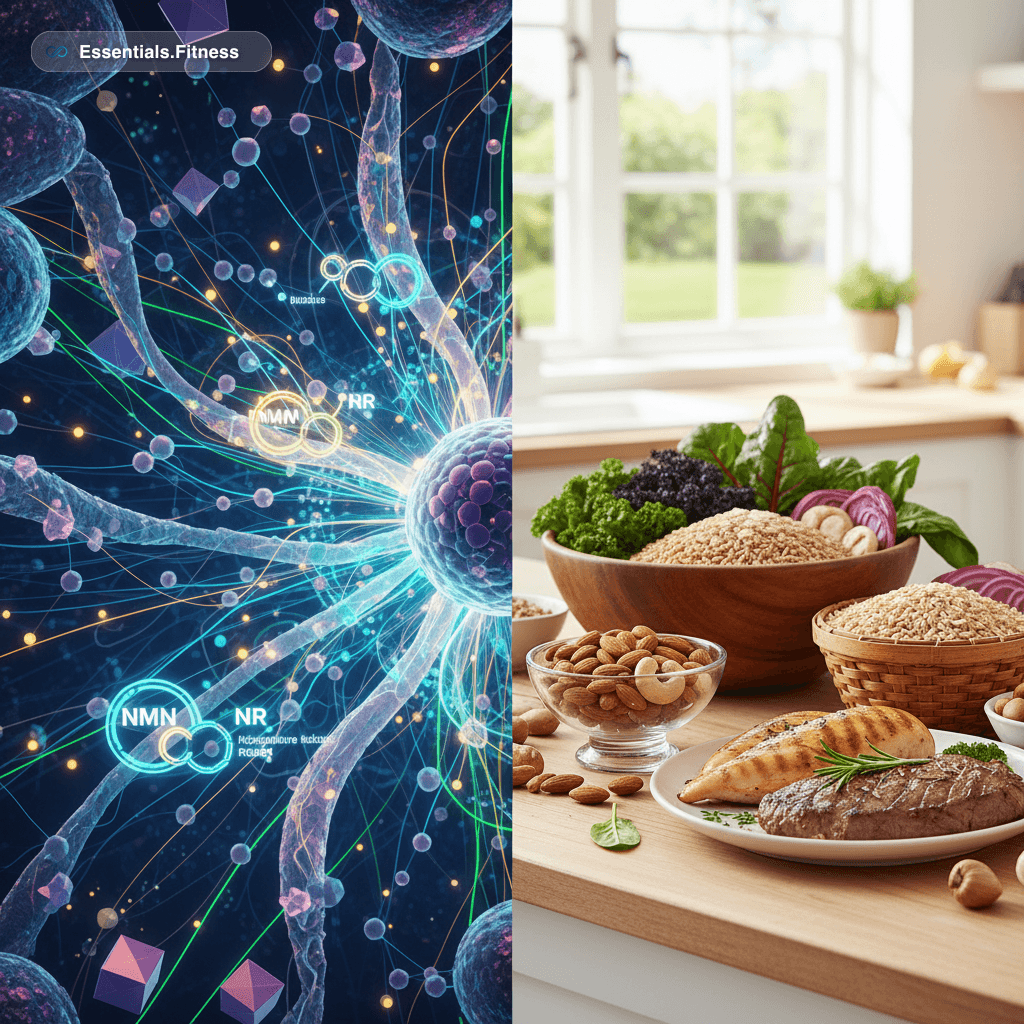
NAD+ Precursors vs. B Vitamins: What's the Better Boost for Your Health?
NAD+ precursors like NMN and NR directly boost cellular NAD+ levels, while B vitamins offer broader metabolic support. Discover the key differences.
Contents
In the pursuit of optimal health and longevity, two categories of supplements often come into focus: NAD+ precursors vs. B vitamins. Both play vital roles in cellular function, energy production, and overall well-being, but they operate through distinct mechanisms and offer different benefits. Understanding these differences is key to making informed choices about your supplementation strategy. This article will delve into what each of these compounds offers, how they compare, and which might be the right choice for your health goals.
Understanding NAD+ Precursors
NAD+ precursors are compounds that the body can use to synthesize Nicotinamide Adenine Dinucleotide (NAD+). NAD+ is a crucial coenzyme found in every cell of your body, essential for hundreds of metabolic processes, including energy production, DNA repair, and the regulation of cellular aging. As we age, NAD+ levels naturally decline, contributing to various age-related health issues.
The most well-known NAD+ precursors currently generating significant scientific interest are Nicotinamide Mononucleotide (NMN) and Nicotinamide Riboside (NR). These compounds are considered direct precursors because they efficiently convert into NAD+ within cells.
Research indicates that supplementing with NMN and NR can effectively increase NAD+ levels, potentially leading to a range of health benefits. Preclinical studies have shown promise in reducing inflammation, combating cellular senescence, and enhancing cognitive function. For instance, a systematic review highlighted the therapeutic potential of NAD+ precursors for cognitive diseases in preclinical rodent models. Human clinical trials are ongoing to further investigate their efficacy and safety, with promising early results suggesting improvements in various metabolic markers and energy levels. However, experts emphasize the need for more data from large Phase 3 or 4 clinical trials to fully understand optimal dosing, long-term effects, and safety, especially for doses exceeding approved daily recommendations.
Beyond their direct role in boosting NAD+ levels, recent evidence also suggests that NAD+ and its precursors like NR and NMN can modulate gut microbiota. This interaction could be one of the underlying mechanisms contributing to the beneficial effects observed, linking gut health to broader cellular well-being.
The Broad Spectrum of B Vitamins
B vitamins are a group of eight water-soluble vitamins that are crucial for various metabolic processes in the body. Unlike NAD+ precursors which primarily target NAD+ synthesis, B vitamins have a much broader range of functions, including:
- Energy Production: Many B vitamins are coenzymes in pathways that convert food into energy.
- Nervous System Function: Essential for nerve health and neurotransmitter synthesis.
- Red Blood Cell Formation: Important for preventing anemia.
- DNA Synthesis and Repair: Crucial for cell division and genetic health.
- Hormone Production: Involved in the synthesis of various hormones.
The B vitamin complex includes B1 (Thiamine), B2 (Riboflavin), B3 (Niacin), B5 (Pantothenic Acid), B6 (Pyridoxine), B7 (Biotin), B9 (Folate), and B12 (Cobalamin). Each plays a unique and indispensable role in maintaining overall health.
Niacin (Vitamin B3): A Bridge Between Worlds
Here’s where the comparison becomes nuanced: Niacin, also known as Vitamin B3, is itself an NAD+ precursor. Niacin exists in several forms, including Nicotinic Acid and Nicotinamide, both of which can be converted into NAD+ in the body. In fact, NMN and NR are also derivatives of vitamin B3, often referred to as 'next-generation' B3 forms or 'NAD+ boosters' due to their direct and efficient pathways to NAD+.
- Nicotinic Acid: Can boost NAD+ but often causes a temporary 'niacin flush.'
- Nicotinamide (NAM): A common form of B3 that also serves as an NAD+ precursor, but its conversion pathway to NAD+ can be regulated by certain enzymes, potentially limiting its direct impact compared to NMN or NR at higher doses.
- Nicotinamide Riboside (NR) & Nicotinamide Mononucleotide (NMN): These are considered more direct and efficient routes to boosting NAD+ levels compared to traditional nicotinic acid or nicotinamide, bypassing some rate-limiting steps in the NAD+ salvage pathway. This directness is why they are often highlighted separately from the broader B vitamin complex when discussing NAD+ optimization.
So, while B vitamins encompass a wide array of functions, Vitamin B3 (Niacin) is uniquely positioned as both a general B vitamin and a fundamental NAD+ precursor.
Key Differences: Direct Boost vs. Holistic Support
The primary distinction between NAD+ precursors like NMN/NR and the broader B vitamin complex lies in their specificity and primary focus:
- Specificity of Action: NMN and NR are highly specific. Their main biological role is to serve as direct building blocks for NAD+. While they may have other effects, their core function is centered around NAD+ metabolism. In contrast, most other B vitamins (B1, B2, B5, B6, B7, B9, B12) are involved in a much wider array of metabolic functions, independent of direct NAD+ synthesis.
- Targeted vs. General Benefits: If your primary goal is to directly increase cellular NAD+ levels to potentially address age-related decline or specific cellular energy concerns, NMN or NR are more targeted. If you are looking for general metabolic support, improved energy levels across various pathways, nervous system health, or addressing specific nutrient deficiencies, a B-complex supplement might be more appropriate.
- Research Focus: While B vitamins have been extensively researched for decades for their roles in preventing deficiencies and supporting overall health, NAD+ precursors like NMN and NR are at the forefront of contemporary research in longevity, anti-aging, and cellular resilience. This means that while traditional B vitamins have well-established safety profiles and recommended daily allowances, research on optimal dosing and long-term effects of NMN/NR is still actively developing.
Similarities and Synergy
Despite their differences, it's important to recognize that both NAD+ precursors and B vitamins are critical for cellular health. They are not necessarily mutually exclusive and can even be complementary.
- Interconnected Pathways: All B vitamins contribute to a healthy metabolism, which in turn supports the cellular environment where NAD+ functions. A deficiency in any B vitamin can negatively impact overall cellular health and indirectly affect energy production, potentially hindering the optimal function of NAD+ dependent processes.
- Potential for Synergy: Some research suggests that NAD+ boosters might have synergistic effects with other healthy lifestyle strategies, such as aerobic exercise or heat therapy. It's plausible that ensuring adequate levels of all B vitamins provides a robust foundation upon which targeted NAD+ precursor supplementation can yield even greater benefits.
Choosing What's Right for You
Deciding between NAD+ precursors and B vitamins, or whether to take both, depends on your individual health goals, current health status, and dietary intake.
- Consider NAD+ Precursors (NMN/NR) if: You are specifically interested in anti-aging, improving cellular energy, cognitive function, and are willing to explore cutting-edge supplements with ongoing research. It's particularly relevant for older individuals or those experiencing energy decline.
- Consider B Vitamins (B-Complex) if: You are looking for general health support, sustained energy, nerve health, or if you have dietary restrictions (e.g., veganism requiring B12 supplementation) that might lead to deficiencies. A B-complex is often a good foundational supplement for overall metabolic health.
- Consider Niacin (B3) if: You want to support NAD+ levels through a well-established B vitamin pathway, though NMN/NR are typically considered more potent for direct NAD+ elevation.
Current Research and Future Outlook
The field of NAD+ metabolism and signaling is rapidly advancing. The 2024 FASEB Scientific Research Conference on NAD Metabolism and Signaling highlights the vibrant research community dedicated to understanding these pathways. Clinical trials are continuously shedding light on the therapeutic potential of NAD+ precursors. However, researchers, like Tzoulis, emphasize the need to await more data from large Phase 3 or 4 clinical trials before definitive recommendations on higher doses. Patients are advised to refrain from using doses of NAD+ precursors that exceed approved daily recommendations for each product, as safety for higher doses is still under investigation.
Conclusion
Both NAD+ precursors vs. B vitamins are vital for health, but they serve different primary roles. While NMN and NR offer a targeted approach to boosting NAD+ levels for cellular energy and potential longevity benefits, B vitamins provide comprehensive support for a vast array of metabolic processes, with Niacin (B3) uniquely bridging both categories. Your choice should align with your specific health objectives, supported by a balanced diet and, crucially, guidance from a healthcare professional. As research continues to evolve, our understanding of these powerful compounds will only deepen, offering new avenues for optimizing health.
You might also be interested in
Sources & Studies
- [1]From Bench to Clinic: The 2024 FASEB Scientific Research Conference on NAD Metabolism and Signaling - PMC. (2026). https://pmc.ncbi.nlm.nih.gov/articles/PMC12579426/
- [2]A systematic review of the therapeutic potential of nicotinamide adenine dinucleotide precursors for cognitive diseases in preclinical rodent models - PMC. (2026). https://pmc.ncbi.nlm.nih.gov/articles/PMC11877801/
- [3]NAD+ Precursors Nicotinamide Mononucleotide (NMN) and ... - PMC. (2026). https://pmc.ncbi.nlm.nih.gov/articles/PMC10240123/
- [4]Dietary Supplementation With NAD+-Boosting Compounds in Humans. (2026). https://pmc.ncbi.nlm.nih.gov/articles/PMC10692436/
- [5]Effects of nicotinamide riboside on NAD+ levels, cognition, and .... (2026). https://pmc.ncbi.nlm.nih.gov/articles/PMC12675013/
Comments
Be the first to leave a comment.