
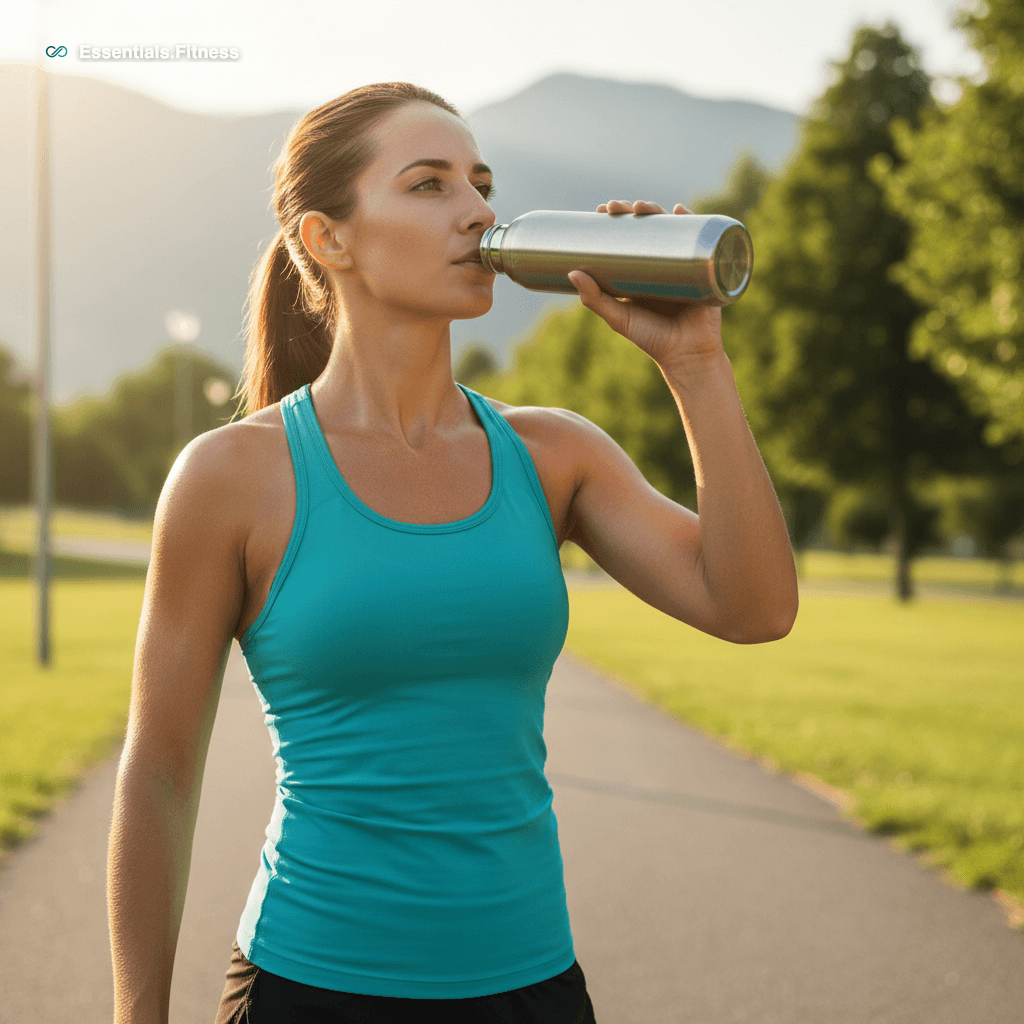
Drinking During Training: How Water, Salt and Performance Really Connect
How much should you drink during exercise, and when do you need salt with it? Blanket litre guidelines miss the mark, while personal sweat rate and sodium loss matter far more. What current evidence shows about thirst, scheduled drinking and hyponatremia.
When too much water is more dangerous than too little
At the Houston Marathon, 21 runners ended up in the medical tent with hyponatremia (a blood sodium concentration below 135 mmol/L). All had drunk too much, not too little. That's 0.31% of the starters. Sounds tiny, but it's striking for a sport whose supposed biggest risk is dehydration. In standard marathons, asymptomatic hyponatremia runs between 7 and 15%, with severe cases under 1% (Klingert et al., 2022).
So what does a sensible drinking strategy actually look like? Less universal than most recommendations suggest.
The 2-percent rule and its ecological problem
The standard claim: lose more than 2% of body weight to sweat, and your endurance performance drops. That number comes from lab studies with controlled pace, climate-controlled chambers and prescribed fluid intake.
In real races, the picture changes. A study of a 161 km ultramarathon found no performance correlation between weight loss (mean 2.0 to 3.1%) and finishing time. Top finishers in ultra events routinely lose 3 to 4% of body weight without any visible drop in output (Hoffman & Stuempfle, 2014). The likely explanation: in the lab, the protocol forces a pace that dehydrated muscle can't hold; in the field, the body just paces itself, and perceived effort rises more slowly.
That doesn't make dehydration harmless. But the "2%" line as a hard threshold doesn't transfer cleanly to real training.
Sweat sodium: 10 to 90 mmol/L, and that's normal
The salt question varies even more than fluid volume. Sweat sodium concentration between individuals ranges from about 10 to over 90 mmol/L. Drivers include heat acclimation, sweat rate, dietary salt intake, sex and genetics (Baker et al., 2023).
Practical consequence: if an athlete with low salt loss gets the same electrolyte recommendation as a "salty sweater" running 80 mmol/L, the advice is wrong for at least one of them. Blanket salt-tablet protocols are at best useless, at worst they trigger GI distress.
Measuring your own sweat rate
The simplest test takes 60 minutes:
- Weigh yourself naked and dry before a typical training session. A body scale with 100 g resolution is enough.
- Train for 60 minutes at usual intensity. Try not to drink anything during the test.
- Weigh yourself again, dry.
The difference in grams roughly equals your sweat rate per hour in millilitres (1 g ≈ 1 mL). Lose 800 g, you sweat about 800 mL per hour. If you do drink during the test, add the volume you drank to the difference.
Drink to thirst, or by the clock?
The research is messier than either camp wants to admit. A 2024 study showed that a personalised drinking strategy extended high-intensity exercise duration in heat by nearly 40% (765 s vs. 548 s in the control) (Li et al., 2024). A recent ultra-running review pulls in the opposite direction: athletes who drink spontaneously to thirst perform at least as well as scheduled drinkers, often with fewer GI complaints (Wierick et al., 2025).
A workable heuristic from the current evidence:
- Under 90 minutes in moderate temperatures: thirst is enough. That's it.
- 90 minutes to two hours in heat: thirst plus roughly 400 to 600 mL per hour if thirst kicks in late.
- Over two hours, in heat, or at race intensity: a structured plan based on your own sweat rate, plus 0.5 to 0.7 g of sodium per litre of fluid (the ACSM recommendation).
Not sure whether your session counts as "long enough" to justify a plan? A long Zone 2 ride or run in summer is a useful benchmark, since you stack moderate heat load over multiple hours.
Hyponatremia: the underestimated risk
Exercise-Associated Hyponatremia (EAH) means plasma sodium drops below 135 mmol/L during or after exercise. It almost never happens through salt loss alone. The cause is fluid intake faster than the kidneys can excrete.
Risk profiles from the data are pretty clear. Long efforts over four hours in warm conditions raise the risk, especially when frequent aid stations encourage continuous drinking. Add a low BMI and limited race experience. Add NSAIDs (painkillers like ibuprofen, which blunt renal water excretion) taken before or during the event. The clearest warning sign is drinking past your own sweat rate, often visible as weight gain during the race.
Two myths refuse to die. "Salt tablets protect me from hyponatremia" is wrong. The main driver is water volume relative to plasma sodium; salt tablets shift that balance only partially. The second: "EAH doesn't matter at shorter distances." Only partly true. Below the marathon, prevalence is genuinely low, but at the marathon itself it's relevant, and in triathlon, hiking, and cycling, cases also surface under four hours (Armstrong et al., 2025).
Where the research is still open
What we don't know yet: how much heat-acclimation protocols shift sweat sodium concentration over the first ten to fourteen days, and how that should translate into a concrete salt recommendation. Studies are running, consistent values aren't in. So if you suddenly start aggressive sodium supplementation in summer because some online post said you should, treat it sceptically. In short: it doesn't work for everyone.
You might also be interested in
Sources & Studies
- [1]Klingert M, Nikolaidis PT, Weiss K, Thuany M, Chlíbková D, Knechtle B. Exercise-Associated Hyponatremia in Marathon Runners. (2022). 10.3390/jcm11226775
- [2]Hoffman MD, Stuempfle KJ. Hydration strategies, weight change and performance in a 161 km ultramarathon. (2014). 10.1016/j.rinphs.2014.04.002
- [3]Baker LB, et al.. Explaining variation in sweat sodium concentration: effect of individual characteristics and exercise, environmental, and dietary factors. (2023). https://pmc.ncbi.nlm.nih.gov/articles/PMC9942894/
- [4]Li H, Early KS, Zhang G, Ma P, Wang H. Personalized Hydration Strategy to Improve Fluid Balance and Intermittent Exercise Performance in the Heat. (2024). 10.3390/nu16091341
- [5]Wierick SC, Perez RI, Zhao X, McDermott BP. Hydration Strategies in Ultra-Endurance Running: A Narrative Review of Programmed Versus Thirst-Driven Approaches. (2025). 10.3390/nu17223526
- [6]Armstrong LE, McDermott BP, Young SL, Casa DJ. Exercise-Associated Hyponatremia: Serum Sodium, Symptomatology, Severity, and Sport Specificity. (2025). 10.2147/OAJSM.S556848
Comments
Be the first to leave a comment.