How much protein per day, really? What the studies show on amount, age and sport
The RDA says 0.8 g per kg. Meta-analyses of 1,800+ lifters say 1.6 g. Older adults need more, and in a calorie deficit it pays to go higher. What the numbers mean in grams, how to spread them across the day, and where the kidney myth actually stands.
Contents
- What does "1 g per kg body weight" actually mean?
- The 0.8 g per kg RDA: what it actually means
- 1.6 g per kg: the muscle-building plateau
- Older adults need more, not less
- Calorie deficit: more protein protects muscle
- Spread: 3 to 5 meals, about 0.4 g per kg each
- Timing around training
- Too much protein: the kidney myth
- If you don't have time to track this
For muscle building, 1.6 g of protein per kg of body weight per day is enough. Going higher doesn't add measurable fat-free mass in young, healthy lifters on average. Past age 65 the requirement climbs to 1.2 to 1.3 g per kg. In a calorie deficit more helps because you need to protect muscle from catabolism. That's the whole post in four sentences. If you want to understand the numbers and translate them onto your plate, read on.
What does "1 g per kg body weight" actually mean?
Most recommendations scale with body weight. "1.6 g per kg" means: at 80 kg body weight, 128 g of protein per day. At 60 kg, that's 96 g. The scaling uses actual body weight, not goal weight. The exception is severe obesity, where some reviews use ideal weight or fat-free mass instead, because otherwise the numbers get silly (a 140 kg adult at 1.6 g would need 224 g per day, which almost nobody hits without shakes).
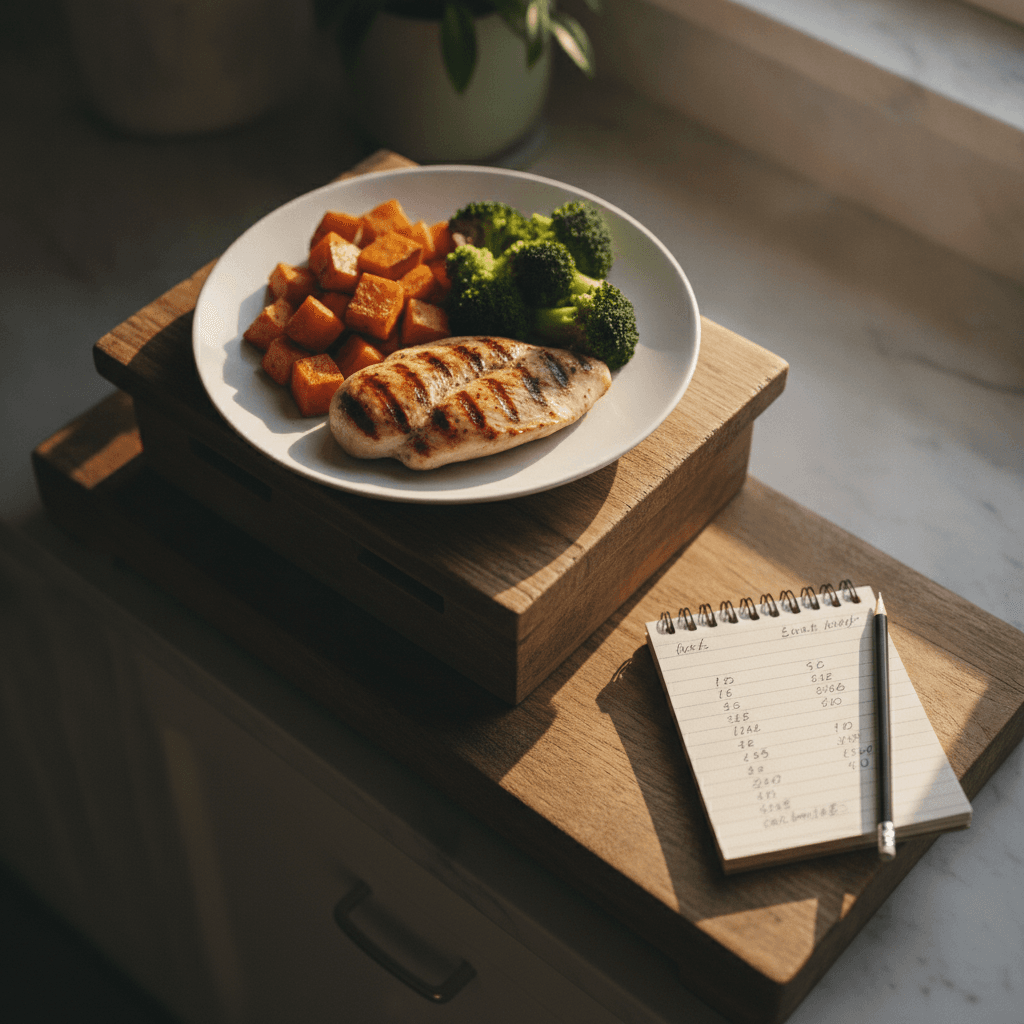
What needs to add up on a real day depends on which foods you pick. 30 g of protein looks roughly like:
- 130 g cooked chicken or turkey breast
- 150 g cooked lean fish (cod, pollock)
- 500 g low-fat quark
- 250 g full-fat Greek yogurt
- 5 medium eggs
- 200 g ground beef (80/20)
- 1 scoop (30 g) whey powder plus 200 ml milk
- 200 g tempeh or 350 g tofu
So 128 g of protein per day means roughly four such portions. Not heroic, not trivial, it takes planning.
The 0.8 g per kg RDA: what it actually means
The German and US reference intake sits at 0.8 g per kg. That number comes from nitrogen balance studies in the 1970s and 80s and describes the amount an average sedentary adult needs to avoid a negative nitrogen balance. It's the absolute minimum to not lose muscle and organ tissue.
That's a completely different question from "how much protein do I need to build muscle, feel fuller, and stay strong as I age?" Two newer methods that get around the nitrogen balance limitations point to higher numbers. The indicator amino acid oxidation technique (IAAO) measures the intake at which the body starts oxidizing excess amino acids. Using this method, Rafii et al. 2015 found a mean requirement of about 1.0 g per kg in women over 65 and a recommended value (RDA equivalent) of 1.2 g per kg. Almost twice the official RDA.
1.6 g per kg: the muscle-building plateau
The best datapoint for lifters is the meta-analysis by Morton et al. 2018 in the British Journal of Sports Medicine. 49 randomized trials, 1,863 participants, all resistance-trained. Core finding: the positive effect of protein on fat-free mass rises up to a daily intake of about 1.62 g per kg and flattens after that. In the pooled dataset, going higher added nothing.
That plateau is a mean. Morton's confidence interval reaches up to 2.2 g per kg. Practically: 1.6 g is enough at the median, but if you want a safety cushion or you're in a hard bulking phase, 1.8 to 2.2 g per kg lands closer to the upper edge of the effect. That's also the range Iraki et al. 2019 recommend in a Sports review for natural bodybuilders in the off-season: 1.6 to 2.2 g per kg per day.
One more layer. A dose-response meta-analysis by Tagawa et al. 2020 across 105 studies found that each 0.1 g per kg per day increase in protein intake between 0.5 and 3.5 g per kg was linked to a small gain in fat-free mass. The gain was small but real, and saturated in practice above 1.5 to 1.6 g per kg.
Older adults need more, not less
This is the point most nutrition guidelines still lag on. As you age, your muscle responds less strongly to any single protein meal. The effect is called "anabolic resistance." To trigger the same muscle-building signal a 25-year-old gets from 20 g of whey, a 70-year-old needs roughly 35 to 40 g in one sitting.
The PROT-AGE study group (Bauer et al. 2013), a European consensus paper, recommends 1.0 to 1.2 g per kg per day as a floor for healthy adults over 65. With chronic or acute illness, with resistance training, or with sarcopenia risk, 1.2 to 1.5 g per kg is recommended. Rafii et al. later confirmed the range methodologically with IAAO in women over 65 at around 1.2 g per kg.
Calorie deficit: more protein protects muscle
When you diet, you normally lose fat and muscle at the same time. How much of each depends heavily on your protein intake and whether you lift.
Longland et al. 2016 in the American Journal of Clinical Nutrition show the effect clearly. 40 young men, 40% calorie deficit over 4 weeks, mixed strength and endurance training. One group got 1.2 g protein per kg, the other 2.4 g per kg. The high-protein group lost 4.8 kg of fat and gained 1.2 kg of fat-free mass. The low-protein group lost 3.5 kg of fat and gained only 0.1 kg of fat-free mass. At a 40% deficit, which is a setting where classically everyone loses muscle.
Longland 2016: muscle and fat under a 40% deficit
4 weeks, mixed training, 2.4 g/kg vs 1.2 g/kg protein
The study is small and used untrained subjects, which is why the muscle gain during a deficit is unusually high. But the direction matches what Helms, Aragon and Fitschen 2014 recommend in their contest-prep review: 2.3 to 3.1 g per kg of fat-free mass (not body weight) during a cut, which lands around 2.0 to 2.4 g per kg of total body weight for most trained adults.
Spread: 3 to 5 meals, about 0.4 g per kg each
How you spread the day's protein matters less than the total, but it isn't zero. The reason is the leucine threshold: each meal needs about 2.5 to 3 g of leucine to fully switch on muscle protein synthesis. That translates to roughly 0.4 g of protein per kg body weight in one sitting from a leucine-rich source (animal or whey).
For an 80 kg lifter that's 32 g per meal. Three or four meals a day gives 96 to 128 g total. Which matches the 1.2 to 1.6 g per kg baseline recommendation. Older adults (see above) need bigger portions to overcome anabolic resistance.
Here's what it looks like:
Meal | Example | Protein |
|---|---|---|
Breakfast | 3 eggs + 200 g low-fat quark + 50 g oats | 45 g |
Lunch | 150 g chicken + 200 g rice + vegetables | 40 g |
Snack | 200 g Skyr + berries + nuts | 25 g |
Dinner | 180 g salmon + potatoes + salad | 35 g |
That totals 145 g for an 80 kg adult, or 1.8 g per kg. No shake required, no extra effort beyond normal meals. If meat or fish is hard for you, or if you eat vegetarian, a whey or plant protein powder is the simplest way to close the gap.
Timing around training
The anabolic window hype claimed for years that you had to get protein in within 30 minutes of finishing training or your gains would vanish. Aragon and Schoenfeld 2013 mostly buried that idea in the Journal of the International Society of Sports Nutrition. Their position: with adequate daily protein, the exact timing plays a minor role. What matters is a solid protein meal a few hours before and a few hours after training, which usually falls out of a normal eating schedule.
If you train fasted, a fast protein source (whey) right after makes sense because the gap since your last meal is bigger. If you ate 2 hours before training, you don't need to sprint to a shaker afterwards.
Too much protein: the kidney myth
The fear that high protein damages the kidneys comes from generalizing findings in patients with pre-existing kidney insufficiency to healthy people. In kidney disease, protein restriction is part of the treatment. That's established.
In healthy adults, the picture is different. A meta-analysis by Devries et al. 2018 across 28 studies with 1,358 participants found no effect of high protein intake (up to 3.0 g per kg per day) on glomerular filtration rate in kidney-healthy adults. The International Society of Sports Nutrition considers 2 g per kg safe for all populations, and considerably higher for lifters in its most recent position stands.
That doesn't mean more is always better. Above 2.2 to 2.4 g per kg there's no documented added benefit for muscle or performance in healthy adults, but there are displacement effects: more protein means less carbohydrate or fat within a fixed calorie budget, which can hurt endurance athletes. And protein has around 4 kcal per gram, a non-trivial calorie load, which usually helps in fat loss (satiety) but makes it harder to close the gap in a bulk.
If you don't have time to track this
Three rules that cover 90% of practice:
1. At every main meal, a palm-sized portion of lean meat, fish, egg, tofu, or legumes plus a portion of dairy. 2. After heavy training, add a protein-heavy snack (quark with berries, Skyr, shake, cheese on toast). 3. If you skip meat or fish 2 to 3 days a week, a shake is the simplest gap-filler.
For an 80 kg adult with a normal appetite that lands almost automatically between 130 and 160 g per day. Right in the target zone, no scale needed.
What stays open is the edge case: 1.8 g vs. 2.2 g for hard bulking, 1.2 g vs. 1.5 g in aging, 2.4 g vs. 3.0 g in an aggressive cut. Every corner has studies that find a small edge for the higher number and studies that see no difference. What the meta-analyses agree on: below 1.6 g per kg you leave growth on the table if you lift, above 2.2 g per kg you at best buy a small safety cushion.
Frequently asked questions
Does plant protein count the same as animal protein?
At the same amount, the muscle-building signal from plant protein is slightly weaker because leucine content and digestibility are lower. In practice: if you eat vegan or vegetarian, aim for 1.8 to 2.0 g per kg instead of 1.6 g per kg to get the same effect, and combine sources (legumes plus grains, soy with nuts).
How much protein does a woman need?
The g-per-kg recommendations are sex-neutral. A 60 kg woman lifting weights gets 96 g per day at 1.6 g per kg, or 108 g at 1.8 g. In perimenopause (roughly from age 45), there are signals that 1.8 to 2.0 g per kg makes sense because dropping estrogen accelerates muscle loss, but the evidence base is thinner than for young men or older adults.
Is whey better than real food?
No, just faster. Whey hits the leucine threshold in about 20 g of powder, which you also get from 100 g of chicken. The difference is convenience: after training, on the road, or at breakfast when cooking isn't happening. For daily intake, meat, fish, eggs, dairy, legumes and tofu are the cheaper and more filling base.
What about the kidney myth?
In kidney-healthy adults, the Devries 2018 meta-analysis of 28 studies shows no negative effect of high protein intake (up to 3 g per kg) on kidney function. In existing kidney insufficiency, protein restriction is part of treatment and should be discussed with your doctor. If kidney disease runs in your family, a baseline check (creatinine, eGFR) before very high intakes is worth the effort.
Sources & Studies
- [1]Morton RW, Murphy KT, McKellar SR, Schoenfeld BJ, Henselmans M, Helms E, Aragon AA, Devries MC, Banfield L, Krieger JW, Phillips SM. A systematic review, meta-analysis and meta-regression of the effect of protein supplementation on resistance training-induced gains in muscle mass and strength in healthy adults. (2018). 10.1136/bjsports-2017-097608
- [2]Bauer J, Biolo G, Cederholm T, Cesari M, Cruz-Jentoft AJ, Morley JE, Phillips S, Sieber C, Stehle P, Teta D, Visvanathan R, Volpi E, Boirie Y. Evidence-based recommendations for optimal dietary protein intake in older people: a position paper from the PROT-AGE Study Group. (2013). 10.1016/j.jamda.2013.05.021
- [3]Longland TM, Oikawa SY, Mitchell CJ, Devries MC, Phillips SM. Higher compared with lower dietary protein during an energy deficit combined with intense exercise promotes greater lean mass gain and fat mass loss: a randomized trial. (2016). 10.3945/ajcn.115.119339
- [4]Iraki J, Fitschen P, Espinar S, Helms E. Nutrition Recommendations for Bodybuilders in the Off-Season: A Narrative Review. (2019). 10.3390/sports7060154
- [5]Rafii M, Chapman K, Owens J, Elango R, Campbell WW, Ball RO, Pencharz PB, Courtney-Martin G. Dietary protein requirement of female adults >65 years determined by the indicator amino acid oxidation technique is higher than current recommendations. (2015). 10.3945/jn.114.197517
- [6]Tagawa R, Watanabe D, Ito K, Ueda K, Nakayama K, Sanbongi C, Miyachi M. Dose-response relationship between protein intake and muscle mass increase: a systematic review and meta-analysis of randomized controlled trials. (2020). 10.1093/nutrit/nuaa104
- [7]Aragon AA, Schoenfeld BJ. Nutrient timing revisited: is there a post-exercise anabolic window?. (2013). 10.1186/1550-2783-10-5
- [8]Devries MC, Sithamparapillai A, Brimble KS, Banfield L, Morton RW, Phillips SM. Changes in kidney function do not differ between healthy adults consuming higher- compared with lower- or normal-protein diets: a systematic review and meta-analysis. (2018). 10.1093/jn/nxy197
- [9]Helms ER, Aragon AA, Fitschen PJ. Evidence-based recommendations for natural bodybuilding contest preparation: nutrition and supplementation. (2014). 10.1186/1550-2783-11-20
Comments
Be the first to leave a comment.