
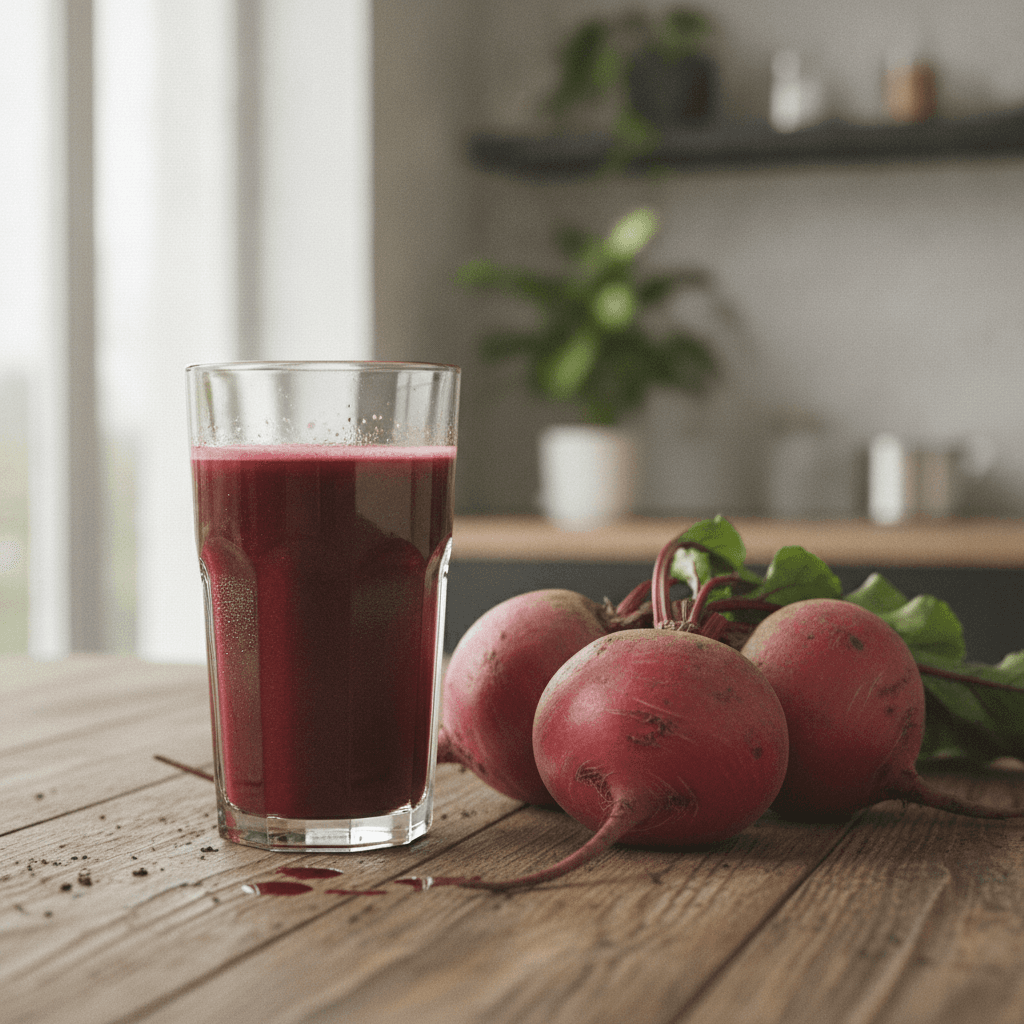
Beetroot in Sports: What Nitrate Really Does for Endurance and VO₂max
Beetroot juice cuts oxygen cost during submaximal exercise by three to five percent. When that's enough to shave seconds off a 10K, why elite athletes don't benefit, and why mouthwash kills the effect.
Contents
Beetroot lowers your oxygen cost during submaximal exercise by three to five percent. At hobby level, that's a few seconds off a 10K. In highly trained athletes the effect disappears. In strength training it doesn't exist. That's the whole article in four lines.
What's left is the interesting stuff: how much juice you actually need, when to take it, and why a pro responds differently than a weekend runner.
Why nitrate in juice changes performance
Beetroot is loaded with nitrate (NO₃⁻), along with rocket, spinach, and Swiss chard. Bacteria in your mouth convert that nitrate into nitrite (NO₂⁻). In your stomach and blood, it then becomes nitric oxide (NO), a signaling molecule that widens blood vessels and helps mitochondria (the cell's energy plants) work more efficiently. Translation: per ATP molecule, the muscle needs less oxygen.
The efficiency gains are small but measurable. They're also the reason beetroot has one of the few ergogenic stories grounded in mitochondrial biochemistry, not marketing.
How big the effect really is
The first study came out of Stockholm in 2007. Larsen et al. 2007 gave nine trained men sodium nitrate for three days. During submaximal cycling, oxygen consumption fell from 2.98 to 2.82 liters per minute, a roughly five percent reduction with no rise in lactate. First hint that nitrate makes muscle more efficient, not just more perfused.
More than 30 follow-up studies later, the picture is more nuanced. The Wong et al. 2022 meta-analysis pooled 24 time-trial studies and found:
- Overall effect on performance: Hedges g = 0.15. That's trivial.
- Chronic loading subgroup (three to 15 days): g = 0.30. Small but positive.
- Acute single-dose subgroup (one shot before race day): g = 0.10. Not significant.
Translation: one bottle two hours before the race does, on average, nothing. Three to seven days of loading does, in the order of one to two percent off a 10 to 40 minute effort.
How much, when, and for how long
The dose-response question got a clean answer from Wylie et al. 2016. Thirty-four participants took either three or six millimoles of nitrate per day, tested at two hours, seven days, and 28 to 30 days.
Three millimoles a day did nothing. Six millimoles cut oxygen consumption significantly at seven and 28 to 30 days. At two hours the effect was borderline (p = 0.06).
Translated into real life:
- Six millimoles of nitrate equals roughly 372 milligrams.
- That sits in about 500 ml of normal beetroot juice, or 70 to 140 ml of a concentrated shot.
- Seven days of loading before a goal race is enough, then maintain or pause.
- Mouthwash on race day kills the bacteria that reduce nitrate. The effect dies with them. So: don't rinse if you've been loading.
Dose | Acute (2 h) | Chronic (7 days) | Chronic (28 to 30 days) |
|---|---|---|---|
Placebo | 0 | 0 | 0 |
3 mmol/day | n.s. | n.s. | n.s. |
6 mmol/day | -3 % (p = 0.06) | -3 % (p < 0.05) | -3 % (p < 0.05) |
Who benefits and who doesn't
The honest part of the story: the more trained you are, the less you respond to nitrate. The Senefeld et al. 2020 systematic review sorted 12 studies by training status.
- Recreational athletes with VO₂max below 55 ml/kg/min: meaningful performance gains.
- Highly trained with VO₂max above 65 ml/kg/min: no detectable effect.
Likely explanation: elite endurance athletes already produce so much NO through their own eNOS pathway that the oral nitrate route adds nothing on top. For most readers, meaning anyone below 55 to 60 ml/kg/min VO₂max, you're still in the responder group. If you don't know your VO₂max from a lab test, a modern fitness tracker gives you a usable estimate.
What beetroot doesn't do: strength training
The resistance-training data is sobering. Tan et al. 2022 gave twelve trained men 12.8 millimoles of nitrate two hours before bench press and back squat to failure. No significant effect on reps, peak power, or velocity. Muscle oxygenation didn't budge.
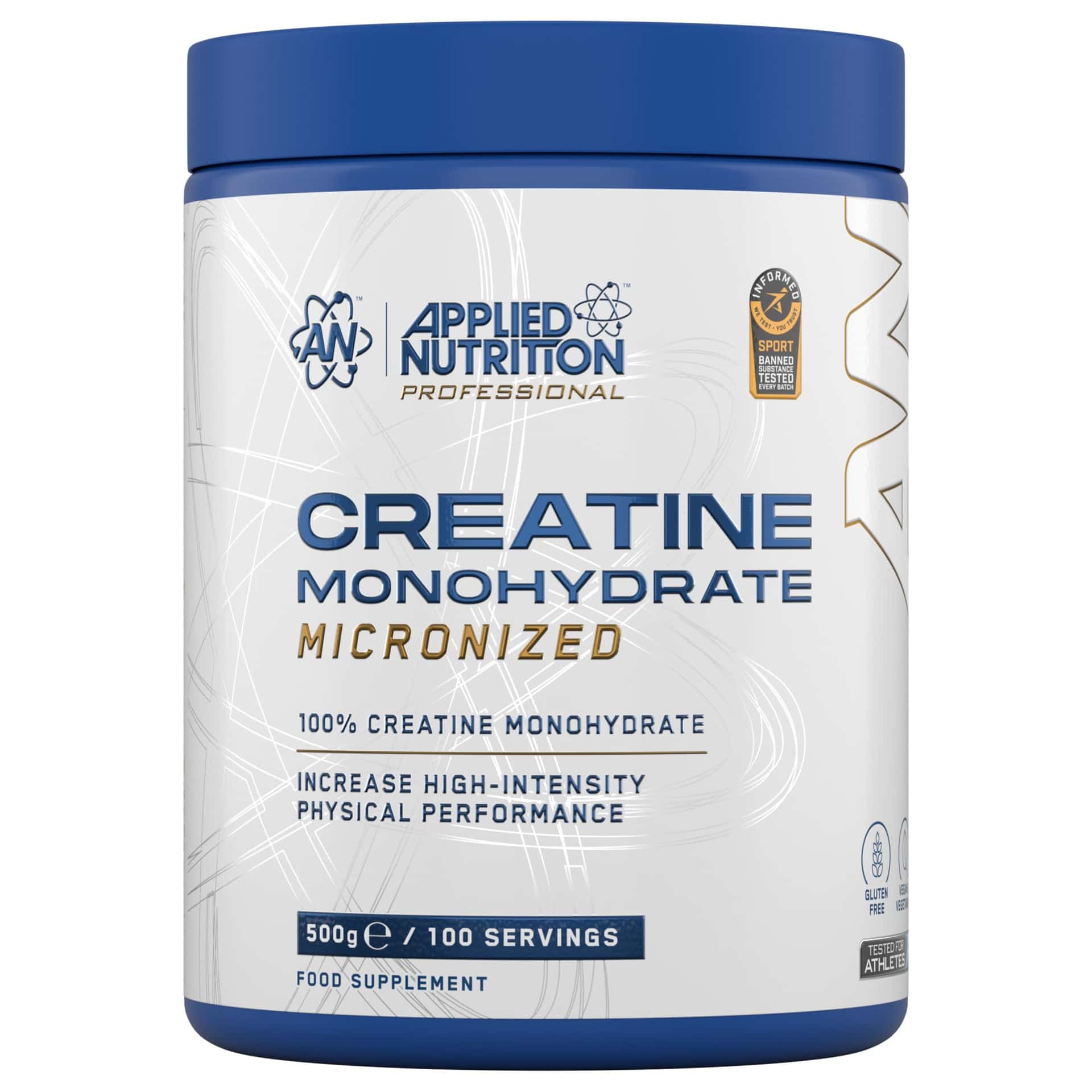
Other resistance studies show the same pattern: small, inconsistent, no clear ergogenic signal. It makes mechanistic sense. A squat set is short, anaerobic work. Mitochondrial oxygen efficiency barely matters there. If you train for strength, creatine is the evidence-backed pick. Nitrate isn't.
How to use beetroot in practice
Side effects are harmless: red-tinted urine and stool (beeturia) and occasional GI upset at higher doses. Concerns about N-nitrosamine formation at very high chronic intakes exist on paper but apply to any vegetable-heavy diet and are considered non-issues in current nutrition science.
What it boils down to
Beetroot is one of the few foods with a real, mechanism-explained, meta-analysis-visible ergogenic effect. But it's small, it only works for submaximal endurance, and it disappears as you approach your genetic ceiling. If you want a miracle pill, keep looking. If you want one percent off a personal best and you like the taste of juice, no reason not to try.
Frequently asked questions
Is beetroot powder as good as juice?
Yes, if the nitrate content is declared on the label. Look for at least 400 mg per serving. Many powders are underdosed because nitrate degrades during drying. A concentrated shot is usually more reliable.
Does it work without a loading phase?
Rarely. The Wong meta-analysis shows no significant average effect from acute single-dose intake (g = 0.10). Three to seven days of pre-loading is the minimum for a measurable benefit.
Does mouthwash really kill the effect?
Yes. Antibacterial mouthwash blocks the nitrite formation on tongue receptors. On days you want the effect, use plain water, or at least skip chlorhexidine-based rinses.
Does beetroot help with high blood pressure?
Yes, modestly. Multiple meta-analyses show four to five mmHg systolic drops. Useful as a lifestyle add-on, not a replacement for medication.
What if I just eat spinach or rocket salad instead?
Works in principle. But 400 mg of nitrate is roughly 200 g of rocket or 250 g of spinach per day, every day. Juice or a shot is easier to dose.
Sources & Studies
- [1]Larsen FJ, Weitzberg E, Lundberg JO, Ekblom B. Effects of dietary nitrate on oxygen cost during exercise. (2007). 10.1111/j.1748-1716.2007.01713.x
- [2]Wylie LJ, Ortiz de Zevallos J, Isidore T, Nyman L, Vanhatalo A, Bailey SJ, Jones AM. Dose-dependent effects of dietary nitrate on the oxygen cost of moderate-intensity exercise: Acute vs. chronic supplementation. (2016). 10.1016/j.niox.2016.04.005
- [3]Wong TH, Sim A, Burns SF. The effects of nitrate ingestion on high-intensity endurance time-trial performance: A systematic review and meta-analysis. (2022). 10.1016/j.jesf.2022.07.002
- [4]Senefeld JW, Wiggins CC, Regimbal RJ, Dominelli PB, Baker SE, Joyner MJ. Effects of Dietary Nitrates on Time Trial Performance in Athletes with Different Training Status: Systematic Review. (2020). 10.3390/nu12092611
- [5]Tan R, Cano L, Lago-Rodriguez A, Dominguez R. The Effects of Dietary Nitrate Supplementation on Performance and Muscle Oxygenation during Resistance Exercise in Men. (2022). 10.3390/nu14183703
Comments
Be the first to leave a comment.